

AI

The age of agentic A complete guide on agents in clinical trials
A complete guide to AI agents in clinical trials, includingwhat they are, the infrastructure they need, where people stay in charge, and how to start. Discover how agentic AI is transforming clinical trials, and what's next. And, learn about ontologies, human-in-the-loop governance, build vs. buy, continuous validation/governance, and more.


What happened at Scope Summit 2026
To many, the SCOPE Summit is the year’s “newsroom,” setting the stage for what hot topics and driving forces will dominate the coming year.
With this year’s conference winding down, we’re once again offering a glimpse into the evolving operational and technological conversations shaping the future of trials with our recap below.

Everest analysis: How Medable eCOA solves speed, patient experience, and customer needs
eCOA has moved from a supporting tool to a foundational pillar of modern clinical trials, and Everest Group agrees. In its inaugural eCOA Products PEAK Matrix Assessment, Everest named Medable a Leader, citing strong market impact, accelerated timelines, and a platform built for real-world trial complexity. As the eCOA market surges toward nearly $1B in value, this recognition underscores how speed, patient experience, and AI-driven innovation are reshaping how trials are designed, launched, and scaled globally.

Build vs buy: A guide on adopting AI agents for life sciences
“Big corporations can’t rely on their internal speed to match the transformation that is happening in the world. As soon as I know a competitor has decided to build something itself, I know it has lost.”
These candid sentences from Sanofi CEO, showcase one of the most common questions that’s at the forefront of every pharmaceutical company’s mind; whether to build or buy your way into the agentic and generative AI revolutions.
In life sciences, many teams start with the same instinct. They see a capable large language model, stand up a proof of concept, and feel close to a breakthrough. For most of us, AI prototypes can look magical. A chatbot summarizes visit reports, drafts emails, or answers protocol questions in minutes. The experience is so strong that teams assume production is a short step away.
Unfortunately, the gap is much bigger than it looks.
According to a recent MIT study, 95% of AI pilots will fail, as they note that “Only 5% of custom GenAI tools survive the pilot-to-production cliff, while generic chatbots hit 83% adoption for trivial tasks but stall the moment workflows demand context and customization.”
Like MIT’s example shows, moving from prototype to production in clinical research means building something validated, compliant, scalable, and integrated into real workflows. That takes far more than clever prompts. It requires domain grounding, continuous monitoring, retraining loops, robust tool orchestration, and evidence that the system is safe and auditable under regulations like GxP, HIPAA, and 21 CFR Part 11.
Many organizations only discover the hidden costs after they have committed. Internal teams often invest for two years, spend millions in sunk cost, and still never reach a dependable clinical grade system. The illusion comes from how easy it is to get an early demo working, and how hard it is to make that demo survive contact with trial reality.


From 3 Meetings to 1: Remove Bottlenecks with AI-Enabled eCOA
This webinar, featuring a product demo, will showcase how AI-enabled eCOA is easing those burdens today. Live in numerous studies, this technology already helps top pharma sponsors and CROs consolidate three meetings into just one, achieve 35X faster first-time eCOA creation, and gain back 4–6 weeks to focus on science and patients.

What happened at ESMO AI & Digital 2025
The 2025 ESMO AI & Digital Oncology Congress, held in Berlin from November 12 to 14, highlighted the accelerating role of artificial intelligence across the oncology care continuum. Although imaging and pathology remain the most established fields for AI adoption, this year’s programming revealed a decisive shift toward workflow-integrated AI that enhances clinical operations, supports trial efficiency, and addresses the realities of patient monitoring.
Across three days of sessions, side-room conversations, and industry demonstrations, one theme was clear. AI is evolving from experimental add-on technology into a practical clinical teammate, but scaling its impact will require robust validation, seamless integration, and a sustained focus on clinician trust.

Faster Trials, Programmatic Scale: Standardizing a Digital Approach Across Therapeutic Areas
Explore how AI and standardization are transforming clinical trial efficiency across multiple therapeutic areas in this expert-led webinar.
Building blocks: The ultimate guide to AI in clinical trials
Explore how artificial intelligence (AI) is fundamentally transforming every facet of clinical trials, from initial protocol design and patient recruitment to data management and regulatory approval. This comprehensive guide provides an authoritative, in-depth look at AI's role in accelerating drug development and improving patient outcomes, with special focus on emerging agentic AI technologies.

Building blocks: Agentic AI is Transforming trial design, management, and outcomes
Discover how Agentic AI is revolutionizing clinical trials by optimizing efficiency, accelerating drug development, and improving patient access to therapies.
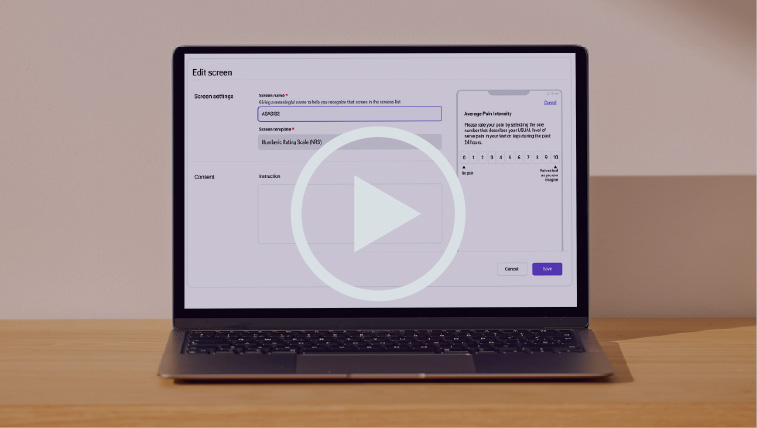
From complexity to clarity: Automate eCOA configuration with AI
Clinical trials are more complex than ever, but building and launching global studies doesn’t have to be. Watch alive demo of our AI-powered eCOA platform to learn more.

Reclaiming your time: How sponsors can save thousands of hours with agentic AI
“For almost a decade, it’s taken nearly eight months on average to get from site identification to study startup completion, when all sites are initiated and ready to enroll patients.”
While it’s often hard to quantify the average time spent on clinical trial activities like study startup, this 2018 quote from Tufts Research author Mary Jo Lamberti showcases the very real problem regarding the time it takes to reach key trial milestones.
In fact, in the seven years since that quote, the clinical trial landscape has only become more complex, with clinical trial cycle times increasing despite technology advances. Cycle times are defined as the total duration from the approval of a clinical trial protocol to the database lock (DBL). As reported by Statista, the average clinical trial cycle from 2020 to 2024 increased by seven months.
Additionally, IQVIA recently released research indicating that almost 50% of drug development time is attributed to non-scientific delays, aka operational bottlenecks that create unnecessary gaps between critical milestones.

Roadmap to adopting AI agents
The successful integration of AI agents in enterprise operations requires a balanced, deliberate approach. Drawing from recent research in Strategic Integration (SI) and agentic AI adoption within large enterprises, the following best practices help maximize value, manage change effectively, and mitigate common pitfalls. Medable Agent Studio specifically streamlines this process by providing robust tools, no-code simplicity, and built-in compliance and security standards.

Guidance for using AI agents effectively
AI agents can play a range of roles, from acting as intelligent collaborators alongside people to independently executing entire workflows. Rooted in the principles of agentic AI, they excel at reasoning through problems, self-directing activities, and adapting to evolving contexts. Whether deployed to support individuals or to autonomously carry out operational tasks, agents enhance productivity, decision-making, and overall efficiency across a broad spectrum of use cases.