


Blog posts

Restoring the American Biotechnology Edge
American biotechnology still leads in scientific innovation, but its advantage in turning science into medicine is eroding. Part 1 examines how slower, more expensive clinical development is shifting the competitive edge toward China, and what’s at stake for the future of U.S. biotech.

DTRA 2024: GSK and Medable discuss change management and DCTs
On Friday, November 15, 2024, the Decentralized Trials & Research Alliance (DTRA) held a fireside chat between Brandon Maggio, GSK’s Global Head of Digital Operations & Process Optimization, and Alison Holland, Medable’s Chief Customer Officer. They were gathered to discuss the evolving landscape of decentralized and digital clinical trials and how best to drive change management in an era of continual changes within trial research. The following blog is a summary of their discussion.
SCOPE 2025: Trends, insights, and news
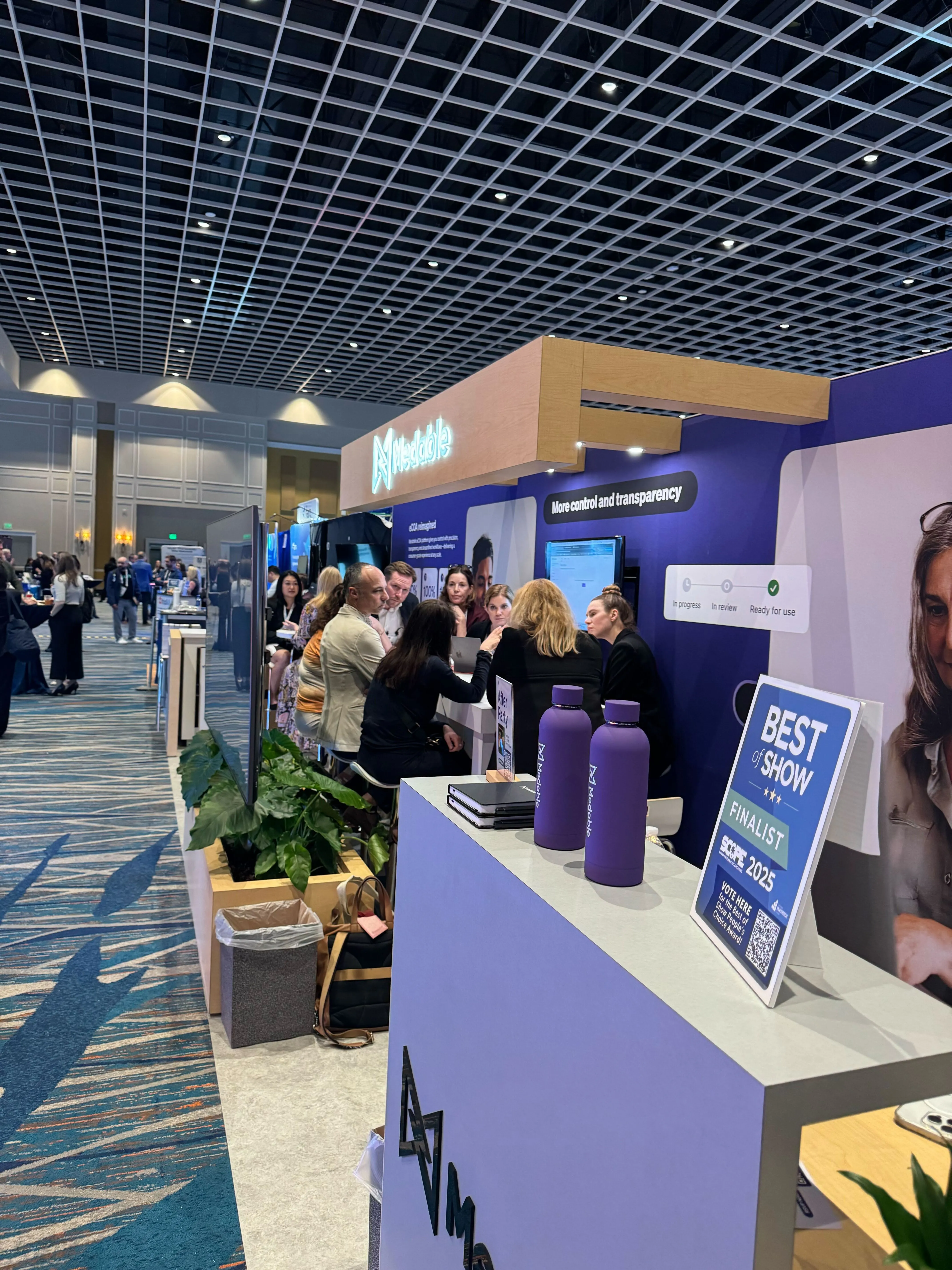
This year’s Scope Summit once again brought thousands in the clinical research space together, offering a glimpse into the evolving operational and technological landscapes shaping the future of trials.

Podcast: Driving Automated Workflows with AI Across Clinical Trials Processes in Drug Development
AI is transforming clinical trials, but how do we harness its full potential? Medable CEO Michelle Longmire joins the Emerj podcast to discuss how AI is reshaping every stage of clinical development—from trial design to patient engagement. Don’t miss this deep dive into the future of AI-powered research.

J.P.M. Week 2025
The J.P. Morgan Healthcare Conference returned to San Francisco this year, bringing significant deals and strategic shifts that signal where healthcare is headed. While this year’s weather outside was dry and sunny, a substantial change from the prior two years' rainy conferences, the conditions inside differed, with several companies making waves.

The big impact of Medable AI
In November, we released an update to Medable Studio titled Medable AI. This latest update furthers Studio's unique value proposition, offering sponsors and CROs unprecedented control over the study creation and launch process, as well as scalability, speed, and streamlining of operations. This provides the easiest, fastest path to study launch in the industry to date.
If this already sounds like something you could use, check out a demo or an in-depth look at its feature set here.
For everyone else, read below to discover what exactly Medable AI has to offer.

The Future of decentralized clinical trials: Opportunities and adaptations for Medable
Traditionally, clinical trials have relied heavily on centralized sites and face-to-face interactions between researchers and participants. However, the limitations of this model have become increasingly apparent, especially during the COVID-19 pandemic, which prompted an unprecedented emergence of decentralized clinical trials (DCTs), whose characteristics of remote patient engagement, virtual assessments, and mobile health technologies allowed the healthcare industry to continue drug development (albeit at a slower pace). As the healthcare landscape continues to evolve, DCTs are emerging as a vital component of the clinical research ecosystem. By leveraging technology and data to streamline processes and the need to enroll a greater diverse patient population, DCTs promise enhanced patient engagement, improved data quality, and accelerated study timelines. As with everything in life, nothing is always that simple. In this blog, we will explore the future of decentralized clinical trials and look at the challenges faced by sponsors, sites, and patients when planning, implementing, and running a DCT. We will also discuss how Medable is continuously adapting its platform and software capabilities to reduce risks and provide solutions that allow the benefits of DCTs listed above to be fully realized.

The science behind Medable’s HEOR
“No one knows their level of pain and how they feel or function better than the patient. Capturing the patient’s response to an electronic Patient Reported Outcome (ePRO) is always the best option.”
Since its inception, Medable has prioritized scientific integrity and rigor around various aspects of clinical trials. As part of its science team, Cindy Howry, VP of eCOA Science, plays a crucial role in ensuring that Medable’s clinical trial platform accurately captures electronic Clinical Outcome Assessments (eCOAs). Hired in 2023, Howry’s chief purpose at Medable is to ensure that the health economics and outcomes research (HEOR) science behind our technology is based on best practices and regulatory guidance.

SaaS’ advancements unlock new possibilities in clinical research
The rise of SaaS has transformed industries, including life sciences, by enabling new possibilities. For instance, Salesforce revolutionized how organizations managed their customers and future clients with its cloud-based software, enhancing accessibility and collaboration. Similarly, Canva made graphic design tools accessible to all, empowering professionals and casual users alike.

How platforms solved clinical trials’ disparate data problem across eCOA, eConsent, and more
Our world is drowning in data.
Humanity generates a staggering 402.74 million terabytes of information every day. From the countless videos we stream to the endless social media scrolling, our global digital footprint is growing exponentially. This data deluge is reshaping industries, influencing our lives, and posing unprecedented challenges.
Within clinical trials, rapidly evolving technologies are enabling researchers to capture new data points as trials grow more complex. However, this poses new challenges in managing clinical trial data.

DPHARM ‘24: Top news and trends from this year’s conference
With the 14th annual DPHARM® wrapping up, we talked to our peers across the industry to find out what the big themes and takeaways were from this year’s conference.

Control and transparency: Solving sponsors’ key challenges in eCOA development and study launch with Studio
There’s no doubt that study launches come with extremely high stakes for sponsors requiring precise coordination over numerous critical activities across multiple stakeholders, including regulatory bodies, ethics committees, investigator sites, and internal teams. Now, sponsors can see exactly what’s happening live across assessments, instruments, translations, and more. This is true whether their internal teams handle launch activities or whether vendors handle them, a stark contrast to the traditional technology development process.

Creating success with digital measures
The landscape of clinical trials is undergoing a significant transformation as digital measures and digital health technologies (DHTs) continue to evolve and prove their worth.
As of December 2023, approximately 1,550 clinical trials worldwide utilized wearable devices, representing about 2% of all trials. While this percentage may seem small, it marks a steady increase since 2014, and the momentum is set to accelerate.