




From protocol to connected study workflow.
Clinical trial protocols are repeatedly interpreted and recreated across documents, workflows, and systems. The Digital Data Flow Agent transforms protocol content into structured, version-controlled data that stays aligned as the study evolves.
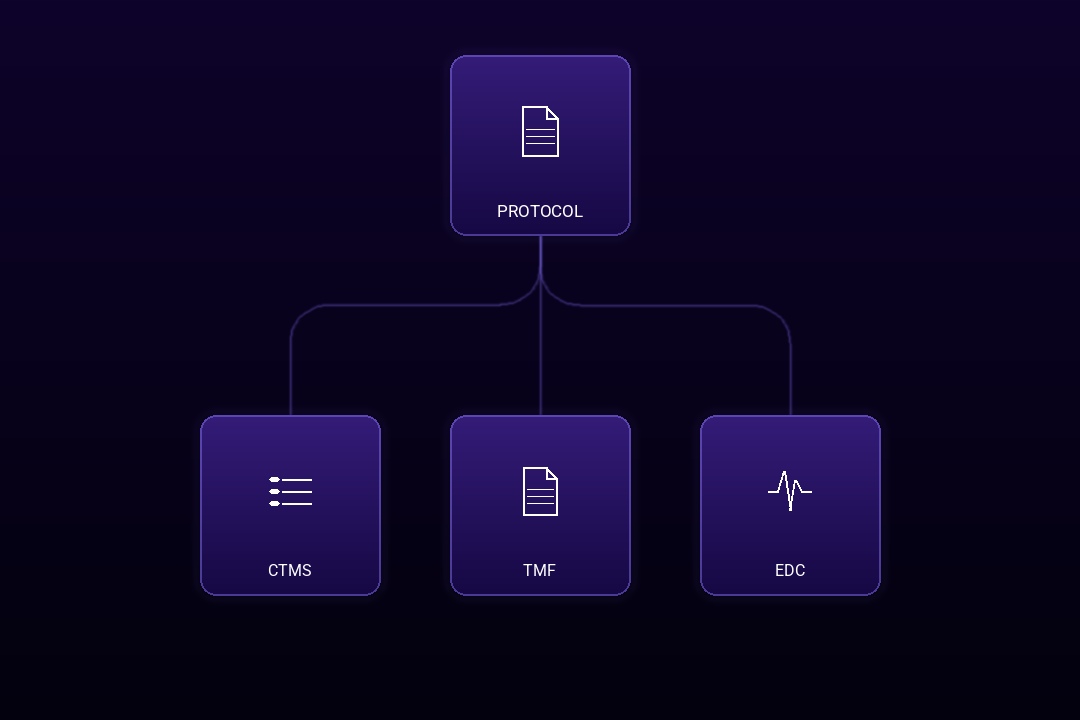
DDF Agent transforms your clinical trial documents
- Turns your protocol into structured, version-controlled data (USDM 4.0)
- Captures schedules, endpoints, eligibility criteria, risk domains, and operational logic in one connected structure
- Generates your SAP, DMP, CMP, and study-build activities from that shared foundation
- Keeps every downstream document synchronized even when a protocol amendment hits
Start studies faster
Reusable structure and automated document generation turn weeks of manual drafting into a fraction of the time so your team gets to first-patient-in sooner.
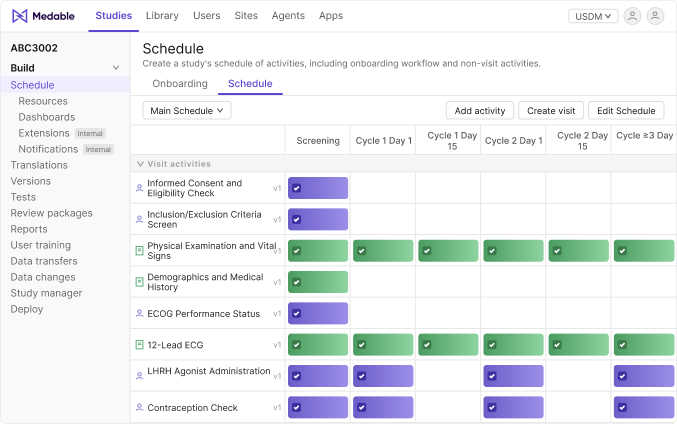
Keep every document aligned
Because the SAP, DMP, CMP, and study build all come from one source, endpoints, KRIs, and data elements stay consistent. No reconciliation passes and no contradictory definitions.
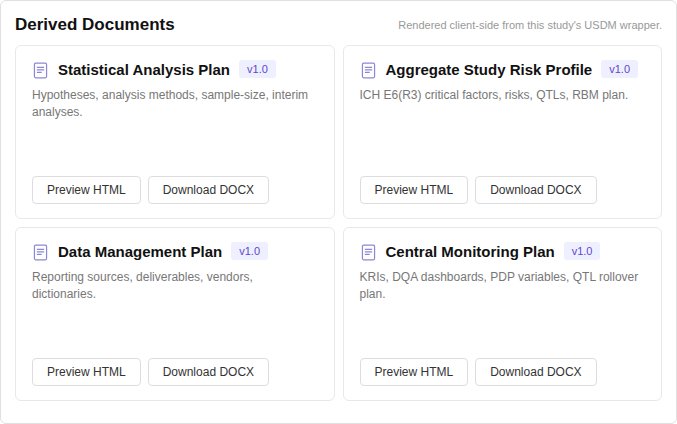
Stay inspection-ready by default
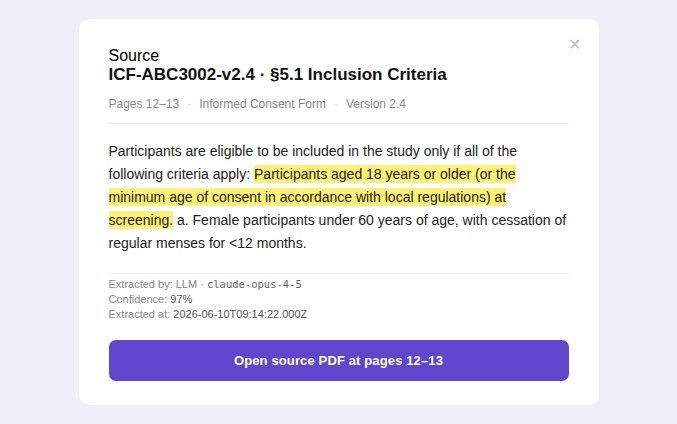
Every output carries source traceability and operational context, so your trial is audit-ready from day one, not assembled in a rush before inspection.
Your experts stay in control
The DDF Agent does the structural work so your scientists can do the science starting from a fundamentally better foundation than a stack of hand-authored documents.
- Output arrives review-ready, with structure and source traceability in place
- Scientific judgment stays with your team: approve, refine, and oversee.
- Every document starts from the same trusted source
- A fundamentally different starting point for clinical trials


Related content


Medable’s Agentic AI connectors and MCPs
Medable’s clinical trial platform leverages a robust network of connectors to integrate seamlessly with the systems that power study execution, from EDC and CTMS to collaboration and data platforms. These connectors enable AI to operate across workflows in real time, unifying data, automating processes, and improving coordination across team
Build vs buy: A guide on adopting AI agents for life sciences
“Big corporations can’t rely on their internal speed to match the transformation that is happening in the world. As soon as I know a competitor has decided to build something itself, I know it has lost.”
These candid sentences from Sanofi CEO, showcase one of the most common questions that’s at the forefront of every pharmaceutical company’s mind; whether to build or buy your way into the agentic and generative AI revolutions.
In life sciences, many teams start with the same instinct. They see a capable large language model, stand up a proof of concept, and feel close to a breakthrough. For most of us, AI prototypes can look magical. A chatbot summarizes visit reports, drafts emails, or answers protocol questions in minutes. The experience is so strong that teams assume production is a short step away.
Unfortunately, the gap is much bigger than it looks.
According to a recent MIT study, 95% of AI pilots will fail, as they note that “Only 5% of custom GenAI tools survive the pilot-to-production cliff, while generic chatbots hit 83% adoption for trivial tasks but stall the moment workflows demand context and customization.”
Like MIT’s example shows, moving from prototype to production in clinical research means building something validated, compliant, scalable, and integrated into real workflows. That takes far more than clever prompts. It requires domain grounding, continuous monitoring, retraining loops, robust tool orchestration, and evidence that the system is safe and auditable under regulations like GxP, HIPAA, and 21 CFR Part 11.
Many organizations only discover the hidden costs after they have committed. Internal teams often invest for two years, spend millions in sunk cost, and still never reach a dependable clinical grade system. The illusion comes from how easy it is to get an early demo working, and how hard it is to make that demo survive contact with trial reality.

Sponsors talk AI: Sanofi's take on the evolving role of AI in clinical trials
Artificial intelligence continues to move from experimentation to execution across the life sciences industry. On a recent episode of the AI in Business podcast, Matthew Peruhakal, Global Head of Data Architecture, Utilization, and AI Engineering at Sanofi, offered a deep look at how the pharmaceutical giant is integrating AI to transform clinical trials. From intelligent data workflows to proactive risk detection and regulatory alignment, Peruhakal described an organization reshaping its research and development operations around a new digital core.
His message was clear: AI cannot remain a side project. To make a meaningful impact, it must be embedded as a strategic capability that connects people, systems, and data across the enterprise.