


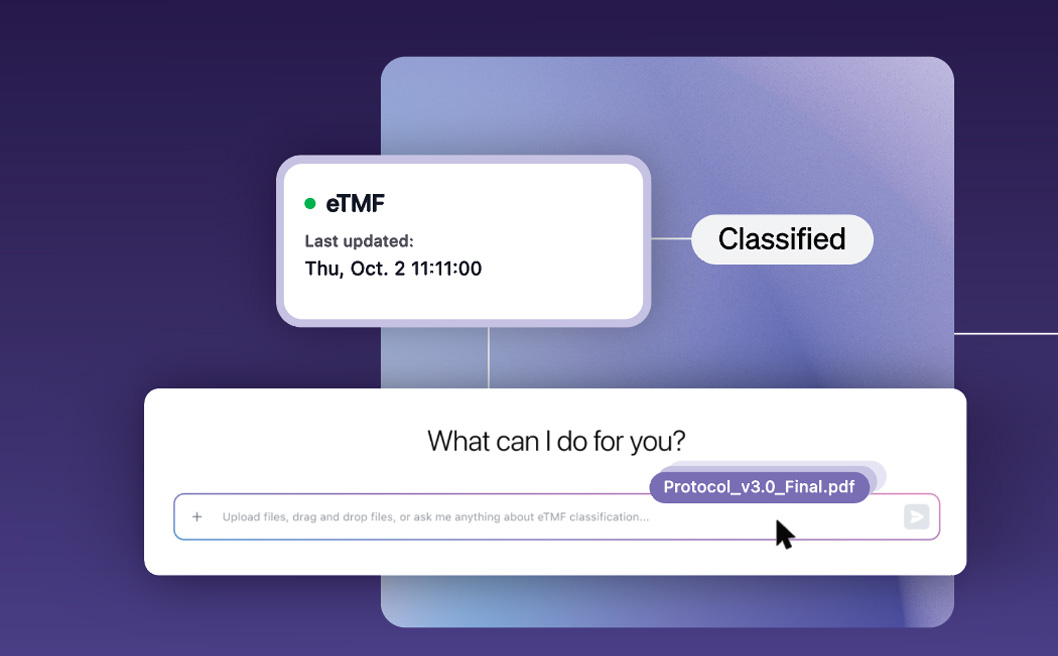

Agentic AI made for clinical trials
Unlock a better way to run trials. Agents help with the manual work, coordination, and day-to-day friction so teams can focus on moving studies forward and making faster decisions.
Built specifically for clinical development with deep GxP, regulatory, and operational expertise, Agent Platform helps run better trials so you can find cures faster.

Launch quickly. Operate intelligently.

1: Connect
Connect your clinical systems to Agent Platform to make faster sense of your data, eliminate manual stitching, and enable real-time data flow for faster decisions.

2: Assist
Use our pre-configured agents to automate filing, proactively identify site risks, generate pre-visit summaries, or build your own agent exactly to your trial’s protocols and needs.

3: Verify
Check your work and get going. Whether you want your agentic teammates to act autonomously or operate with a human in the loop, they move work forward in real time.

4: Evolve
Go beyond static systems with a platform that evolves continuously, with built-in verification and quality assurance designed for clinical development.
Connect your clinical and enterprise systems
Medable connects with the clinical and enterprise tools your organization already uses, right out of the box. Need more? Add the connectors your workflows demand.
- Prebuilt integrations for common clinical and enterprise systems
- Fast onboarding with minimal IT lift
- Flexible connectors that adapt to your workflows
- Secure, compliant data exchange across systems
Say hello to your new agents
Our team of agents for clinical monitoring, TMF management, and PI and audit readiness, make work easier than ever before.

Roadmap to adopting AI agents
The successful integration of AI agents in enterprise operations requires a balanced, deliberate approach. Drawing from recent research in Strategic Integration (SI) and agentic AI adoption within large enterprises, the following best practices help maximize value, manage change effectively, and mitigate common pitfalls. Medable Agent Studio specifically streamlines this process by providing robust tools, no-code simplicity, and built-in compliance and security standards.


The agentic revolution for clinical trials

The latest from Knowledge Center


Ontology 101: The semantic layer behind modern life sciences data
Clinical data speaks dozens of languages. Ontologies are the translator. Discover how life sciences teams are using semantic layers, AI agents, and MCP connectors to cut months of data harmonization down to days.

The best AI tools for remote patient monitoring in clinical trials
AI-powered remote patient monitoring (RPM) is transforming clinical trials by enabling continuous data collection, real-time insights, and decentralized participation. This ecosystem spans wearables, AI analytics, data platforms, and decentralized clinical trial (DCT) infrastructure.
Additionally, agentic AI is fundamentally reshaping remote patient monitoring (RPM) in clinical trials by shifting it from passive data collection to proactive, autonomous decision support. Instead of simply aggregating data from wearables and patient-reported outcomes, agentic systems can continuously analyze multi-source trial data, identify emerging risks, and take action, such as prioritizing at-risk patients or sites, triggering alerts, or recommending interventions, without waiting for human input. This significantly reduces delays in detecting safety signals or protocol deviations. Just as importantly, agentic AI introduces workflow automation at scale by handling routine monitoring tasks, coordinating communications, and maintaining audit-ready reasoning trails. The result is a more adaptive and responsive RPM model where clinical teams move from manual oversight to strategic supervision, enabling faster, safer, and more efficient trials.
Below is a structured overview of the leading vendors, tools, and providers enabling AI-driven RPM in clinical research.

From three meetings to one removing bottlenecks with AI-enabled eCOA
Discover how AI-enabled eCOA and agentic workflows reduce clinical trial startup time, translation cycles, and meeting overhead—cutting eCOA build timelines from 16–20 weeks to under 8 weeks.
Frequently asked questions
Agentic AI refers to autonomous, goal-driven AI systems—often called “agents”—that can reason, plan, and act in complex environments with minimal human intervention. In clinical development, these agents can manage and optimize trial workflows such as protocol design, patient recruitment, site coordination, and regulatory documentation. Unlike traditional automation, which follows static rules, agentic AI adapts to new information, learns from trial progress, and proactively orchestrates tasks to keep studies on track and compliant.
AI agents help clinical trials run faster, more efficiently, and with greater quality. By automating repetitive tasks, adapting protocols in real time, and reducing human error, they streamline operations across sites while ensuring compliance and consistency. They also enable more patient-centric approaches by improving communication and engagement, ultimately making it easier to scale complex global trials with fewer resources.
Delivering trustworthy Agent recommendations requires two key elements:
The AI Model – We select and fine-tune models that are purpose-built for life sciences, trained on high-quality, relevant data. This ensures the model understands domain-specific language, context, and regulatory requirements, reducing the risk of inaccurate or irrelevant outputs.
The Agentic Environment & Verification Process – Agents operate in a controlled environment with rigorous validation checkpoints, business logic guardrails, and real-time monitoring. Every recommendation is subject to verification workflows and data quality checks before it’s surfaced to users, ensuring accuracy, compliance, and auditability.